Flask API Starter for Python
A Flask 3 API starter in Python 3.12 for developers who want a clean JSON API skeleton with no database. It uses an application factory and a blueprint, serves through Waitress locally and Gunicorn on Light Cloud, and comes with pytest tests and ruff linting.
by Light CloudREST APIs
- Flask
 Python
Features
- create_app() in app/__init__.py builds the app and registers the blueprint from app/routes.py
- GET / returns { "message": "Hello from Flask on Light Cloud" } through jsonify
- python main.py serves with Waitress on 0.0.0.0, reading PORT and defaulting to 8000
- Light Cloud runs gunicorn main:app, so the single-threaded development server never goes live
- pytest fixture in tests/conftest.py builds a fresh app per test and uses Flask's test client
- Tests cover the welcome route and a 404 on an unknown path
- ruff configured in pyproject.toml; Flask 3.0.3 and waitress 3.0.0 pinned in requirements.txt
Tech stack

 Flask
 Python
 pytest
 Ruff
What you need
- Free plan: it runs as a server app, and the Free plan includes 3 server apps
- To run it locally: Python 3.12 and pip, in a virtual environment
- No API keys: it starts with nothing to configure
About
main.py builds the app once with create_app() and exposes it as main:app, which is the object both Waitress and Gunicorn serve; the tests call the factory themselves so each one starts clean. Choosing Waitress for python main.py means local runs use the same kind of multi-threaded server as the deployed app. Unknown paths still get Flask's HTML 404 page, so a JSON error handler in create_app() is a sensible first change, followed by your own blueprints. On Light Cloud the deploy installs requirements.txt, adds Gunicorn at build time and runs gunicorn main:app on the platform's PORT, redeploying on every push to your copy.
FAQ
How do I add a new route in Flask?
Add a function to the blueprint in app/routes.py, or create a new blueprint module in app/ and register it in create_app() with app.register_blueprint(things_bp).
Why use Waitress or Gunicorn instead of flask run?
flask run starts Flask's development server, which is single-threaded and not meant for live traffic. This starter serves the same main:app object with Waitress locally and Gunicorn on Light Cloud.
How do I make Flask return JSON for 404 errors?
Register an error handler in create_app(), for example app.register_error_handler(404, lambda e: ({"error": "Not found"}, 404)). Without it, Flask answers with its HTML error page.
Is there a Flask API template with PostgreSQL?
This starter has no database. The flask-postgresql-crud-api template adds PostgreSQL and a full CRUD resource.
Can I deploy this Flask app without Light Cloud?
Yes. Any host with Python 3.12 runs it with python main.py and PORT set, or with any WSGI server pointed at main:app.
Related templates
All rest api starters- Flask CRUD APIStarter · CRUD APIs
- Flask
- Python
 PostgreSQL
Flask CRUD API
Start a Flask CRUD API on PostgreSQL with blueprints, Gunicorn and pytest set up
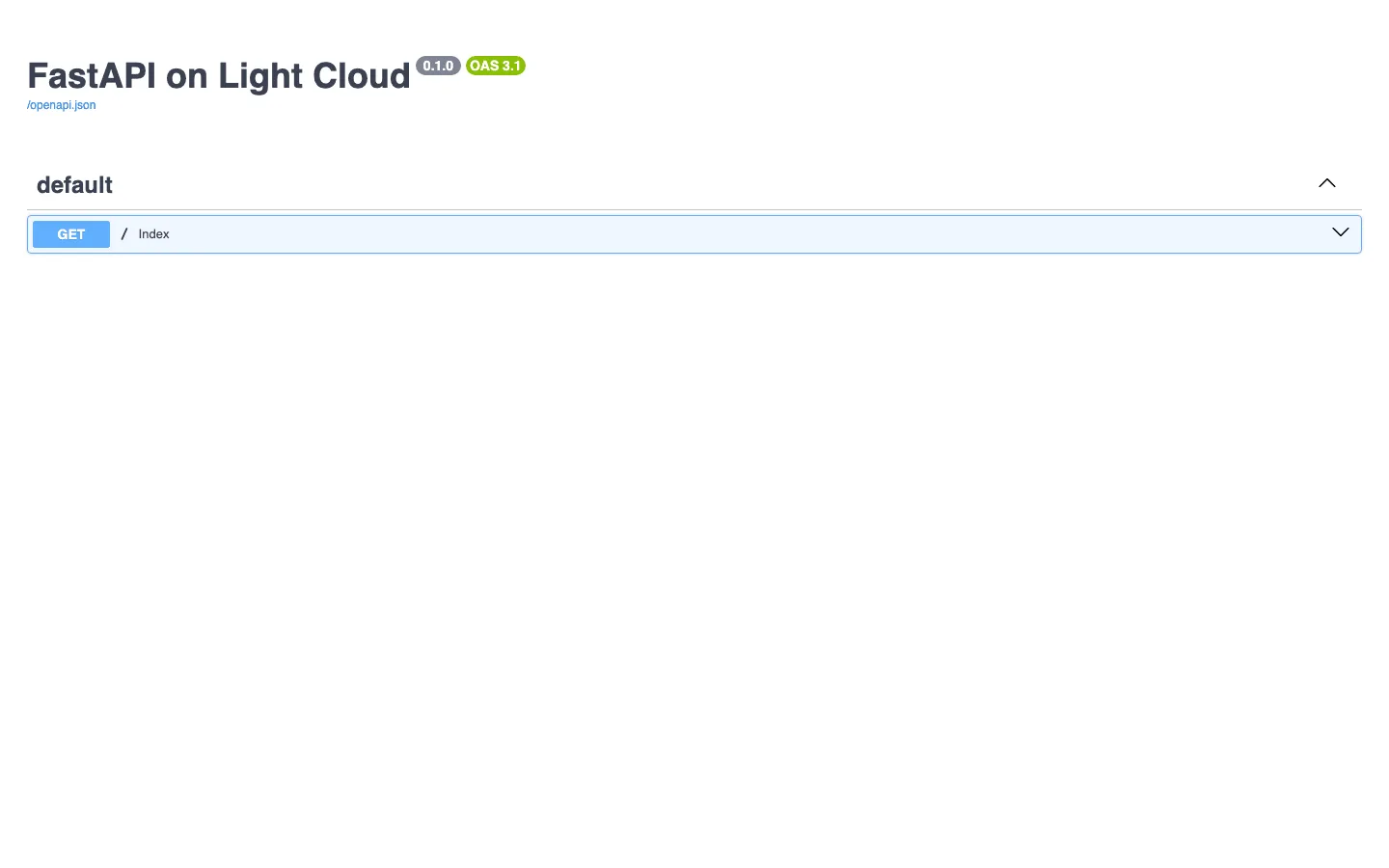
FastAPI
Start a Python REST API with FastAPI, live OpenAPI docs, pytest and ruff set up
 Django CRUD APIStarter · CRUD APIs
- Django
- Python
- PostgreSQL
Django CRUD API
Start a Python CRUD API on PostgreSQL with Django REST framework, migrations and tests